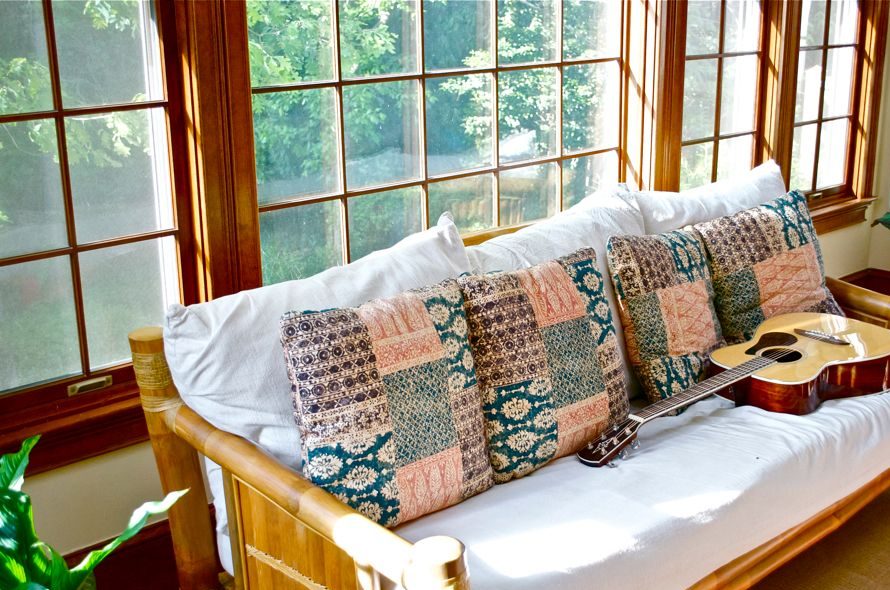
A room with only plain surfaces can feel flat, while a room with too many patterns can feel restless. The sweet spot sits in between: a mix of patterns and textures that gives the eye somewhere to rest and something to enjoy. The good news is that you do not need a designer’s instinct to get there, just a few dependable rules.
Start with a colour story
Before you think about stripes or florals, choose a small family of colours. Pick a main colour for large surfaces, a supporting colour for furniture and textiles, and an accent for small touches. When every pattern in the room shares these colours, very different prints suddenly look like they belong together.
Vary the scale
The quickest way to make patterns clash is to use several of the same size. Instead, combine:
- One large pattern, such as a bold rug, curtains or a feature wall.
- One medium pattern, like a checked throw or a printed armchair.
- One small pattern, for example a fine stripe or a tiny geometric on cushions.
The large pattern sets the mood, the medium one supports it and the small one adds detail up close.
Let texture do the quiet work
Texture adds depth without adding noise. Think of a chunky knit throw on a smooth leather chair, linen curtains beside a glossy lamp, or a woven basket next to a velvet cushion. If a room feels busy, swap a patterned piece for a textured plain one in the same colour.
Give patterns room to breathe
Spread patterns around the room rather than grouping them in one corner. Repeat each pattern or colour at least once elsewhere so it feels intentional. Plain walls, a calm floor or a solid sofa give the eye a place to rest between the livelier pieces.
Build slowly
Add one new pattern at a time and live with it for a few days. It is much easier to see what a room needs when you are not changing everything at once. If you would like a second pair of eyes, our decor team can help you build a palette and choose pieces that work together.